English
×
All rights reserved. All content and images used on this website
belong to EMA Kimya and may not be used without permission.
cour
 EMA Kimya | Concrete Admixtures, Cement Additives, Construction Chemicals, Superplasticizers, High-Range Water Reducers, Concrete Performance Solutions, Ready-Mix and Precast Concrete Technologies, Infrastructure, Industrial Projects, Technical Support, Production and Cost Consulting  EMA Kimya | Concrete Admixtures, Cement Additives, Construction Chemicals, Superplasticizers, High-Range Water Reducers, Concrete Performance Solutions, Ready-Mix and Precast Concrete Technologies, Infrastructure, Industrial Projects, Technical Support, Production and Cost Consulting
EMA Kimya | Concrete Admixtures, Cement Additives, Construction Chemicals, Superplasticizers, High-Range Water Reducers, Concrete Performance Solutions, Ready-Mix and Precast Concrete Technologies, Infrastructure, Industrial Projects, Technical Support, Production and Cost Consulting

"Strength in Every Mix,
Quality in Every Drop"

×

Quality, reliability, and a commitment to sustainable production.

We provide professional solutions in concrete admixtures and construction chemicals.

Menu

Quality, reliability, and a commitment to sustainable production.

We provide professional solutions in concrete admixtures and construction chemicals.

19 September 2026

Choosing the right admixture for ready-mixed concrete production plays an important role in workability, slump retention, pumpability, early and final strength, and long-term durability.

However, concrete admixture selection should not be based only on the technical specifications of a product. Cement characteristics, aggregate properties, water/cement ratio, ambient temperature, transportation time and application conditions should all be evaluated together.

For this reason, professional ready-mix concrete production requires admixture systems tailored to the concrete mix design and production conditions rather than relying on a single standard solution.

What Is a Ready-Mix Concrete Admixture?

Ready-mix concrete admixtures are chemical products added to concrete in controlled amounts to modify or improve specific properties of fresh or hardened concrete.

Concrete admixtures can help reduce water demand, improve workability, control setting time, regulate air content and enhance specific performance characteristics.

In modern concrete technology, chemical admixtures are not considered merely supplementary materials. They are an important part of concrete mix design and overall production performance.

Why Is Choosing the Right Concrete Admixture Important?

Two concrete mixes with the same strength class can still perform very differently on site.

One of the main reasons is that concrete performance is not determined by compressive strength alone.

Concrete must maintain its consistency after leaving the batching plant, remain pumpable, fill formwork effectively, maintain a homogeneous structure without segregation and achieve the required setting time.

Selecting the right concrete admixture helps manage these properties more effectively.

Using an unsuitable product or incorrect dosage can lead to rapid slump loss, unexpected changes in setting time or failure to achieve the targeted concrete performance.

How Does Cement Type Affect Admixture Performance?

The cement used in the mixture is one of the most important factors influencing concrete admixture performance.

The chemical and mineralogical composition, fineness and production characteristics of cement can directly affect its interaction with chemical admixtures.

An admixture that performs very well with one cement type may not deliver the same result with another cement with different characteristics.

For this reason, when changing admixtures in ready-mix concrete plants, compatibility with the existing cement should be evaluated in addition to the technical properties of the product.

Laboratory testing plays an important role in identifying the most suitable admixture system.

Aggregate Characteristics and Fine Material Content

Aggregates make up a significant proportion of the concrete mixture. Therefore, aggregate grading, surface characteristics, moisture content and fine material percentage can influence admixture performance.

Aggregates containing high levels of fine material or clay may increase the demand for certain admixture systems.

This can require adjustments to the admixture dosage in order to achieve the desired concrete consistency.

Regular monitoring of aggregate characteristics helps keep both the concrete mix design and admixture system more stable.

Water/Cement Ratio and High-Range Water-Reducing Admixtures

One of the key parameters affecting concrete performance is the water/cement ratio.

Adding uncontrolled amounts of water to improve workability can negatively affect the strength and durability of hardened concrete.

For this reason, high-performance concrete production generally relies on high-range water-reducing admixtures and superplasticizers instead of simply increasing water content.

With the appropriate admixture system, concrete workability can be maintained while reducing the total water demand of the mixture.

This approach can support a denser, more homogeneous and higher-performance concrete structure.

Transportation Time and Slump Retention

Concrete produced at a ready-mix plant requires a certain amount of time to reach the construction site.

Traffic conditions, long delivery distances and waiting periods on site can all cause concrete to lose consistency.

In such applications, not only the initial slump value at the batching plant but also the concrete's performance after a certain period should be taken into consideration.

Admixtures with strong slump-retention characteristics, and where necessary set-retarding admixture systems, can help maintain workability more effectively during transportation and placement.

Does Temperature Affect Concrete Admixture Selection?

Ambient and concrete temperatures can directly affect the rate of cement hydration.

In hot weather, concrete may lose workability more quickly and the setting process may accelerate.

In cold conditions, hydration and strength development may slow down.

For this reason, using exactly the same concrete mix design and admixture dosage throughout both summer and winter may not always produce consistent results.

Adjusting the admixture system, dosage and concrete mix design according to seasonal conditions can help improve production stability.

Admixture Selection for Pumped Concrete

In high-rise buildings and large-scale projects, concrete may need to be pumped over long distances or to considerable heights.

In these situations, flowability alone is not sufficient.

The concrete mixture must maintain its homogeneity during pumping, resist segregation and move consistently through the pipeline.

High-range water reducers and suitable auxiliary concrete admixtures can help improve pumpability.

Aggregate grading and fine material content should also be evaluated together with the admixture system when designing pumped concrete.

Setting Time in Concrete Admixture Selection

Not every project requires the same setting time.

Short setting times may be important in tunnel and shotcrete applications, while ready-mixed concrete transported over long distances may require extended workability.

Depending on the project, set-accelerating or set-retarding concrete admixtures can be used.

Dosage should be carefully determined when controlling setting time.

Changes made without considering cement type, concrete temperature and environmental conditions may produce unexpected results.

Where Are Air-Entraining Admixtures Used?

In regions exposed to repeated freeze-thaw cycles, concrete durability against environmental conditions becomes an important design requirement.

Air-entraining admixtures help create controlled microscopic air voids within the concrete.

This air-void system can contribute to improved durability in concrete exposed to repeated freezing and thawing.

Road concrete, bridges, outdoor slabs and infrastructure projects in cold climates are common examples of such applications.

The Importance of Laboratory Testing in Concrete Admixture Selection

Selecting a concrete admixture based only on technical data sheets may not always be sufficient.

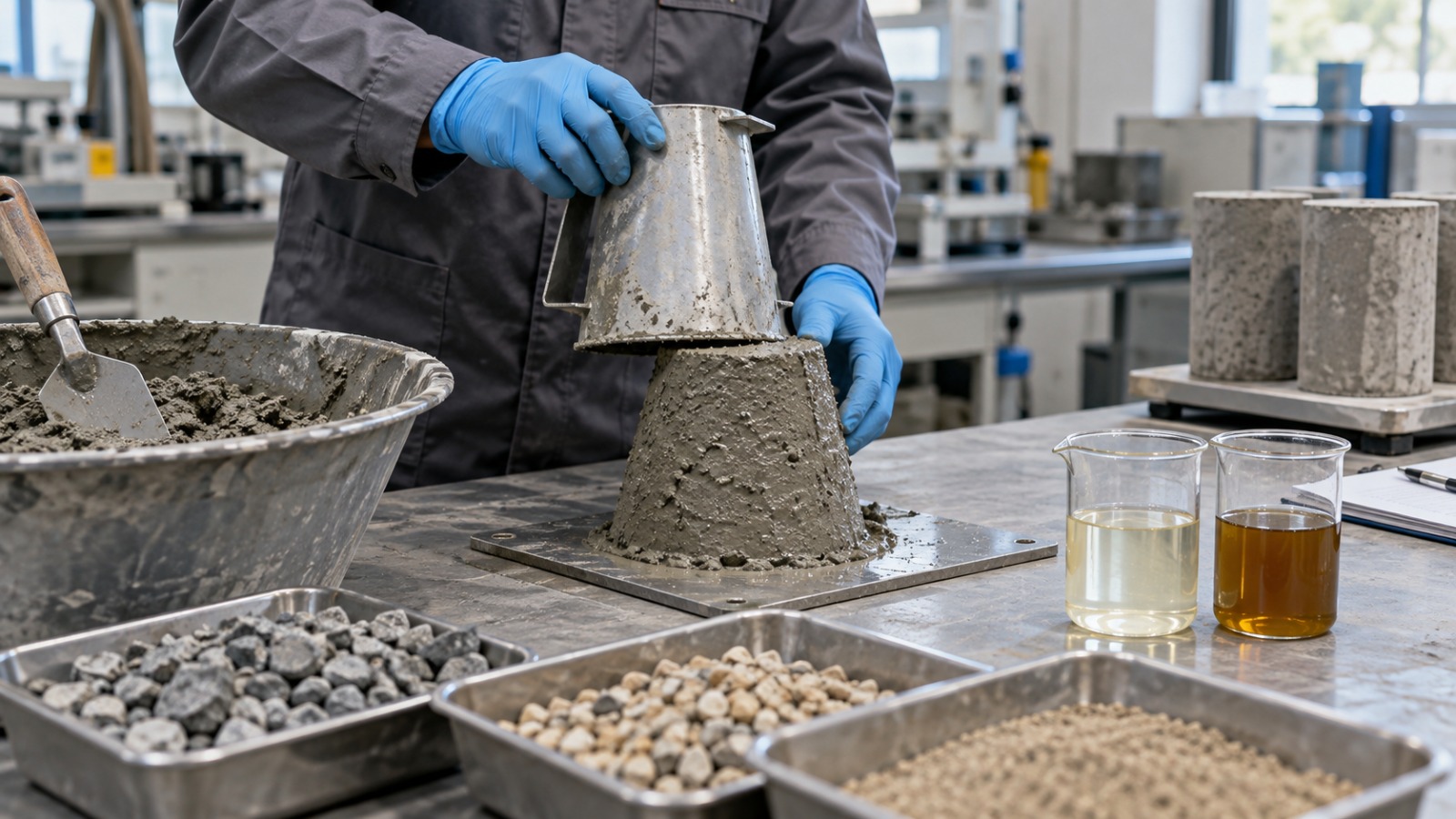
Laboratory trials using the actual cement, aggregates and raw materials intended for production provide a more accurate assessment of admixture performance.

During laboratory testing, initial slump, slump retention over time, setting time, early strength and final strength can all be evaluated.

Based on these results, product type and dosage can be optimized to achieve more stable concrete performance in actual production conditions.

What Affects Ready-Mix Concrete Admixture Prices?

Ready-mix concrete admixture prices should not be evaluated solely on the basis of price per kilogram or ton.

Admixture dosage, water-reduction performance, impact on production efficiency, slump retention and contribution to the targeted concrete performance should all be considered when evaluating total cost.

A lower-priced product that requires a significantly higher dosage may result in a higher overall production cost under certain conditions.

For this reason, performance-to-cost balance should be considered alongside unit price when selecting concrete admixtures.

Technical Support in Professional Concrete Admixture Selection

Raw materials used in ready-mixed concrete production may change over time.

Different cement deliveries, variations in aggregate sources, temperature changes and production intensity can all affect concrete performance.

For this reason, concrete admixture supply should ideally be supported by technical evaluation.

Laboratory studies, batching plant trials and field monitoring can help optimize the admixture system according to actual production conditions.

EMA Kimya Ready-Mix Concrete Admixture Solutions

EMA Kimya develops high-performance concrete and cement admixture technologies for ready-mixed concrete plants, concrete batching facilities, precast and prefabricated manufacturers, cement plants and large-scale infrastructure projects.

From high-range water-reducing and superplasticizing admixtures to set accelerators, set retarders, air-entraining admixtures and auxiliary concrete admixtures, EMA Kimya provides solutions for different production and application requirements.

EMA Kimya's technical approach is based on evaluating cement type, aggregate properties, concrete mix design and project conditions together in order to determine the most suitable admixture system.

The right concrete admixture affects not only flowability, but also production efficiency, application performance, strength and long-term concrete quality.

Related News

What Is Alkali-Silica Reaction (ASR) in Concrete? How Can Internal Cracking and Long-Term Durability Loss Be Prevented?

Publication Date: 19 Eylül 2026

What Causes Efflorescence in Concrete? How Can White Stains on Concrete Surfaces Be Prevented?

Publication Date: 19 Eylül 2026

How Much Concrete Admixture Should Be Used? How Does the Correct Dosage Affect Concrete Performance?

Publication Date: 19 Eylül 2026

What Are Auxiliary Concrete Admixtures? How Can Stability and Performance Be Controlled in Ready-Mixed Concrete?

Publication Date: 19 Eylül 2026

More Efficient Production and Balanced Cement Performance with Cement Grinding Aids

Publication Date: 19 Eylül 2026

What Is a Set-Retarding Concrete Admixture? How Can Concrete Setting Time Be Controlled in Hot Weather?

Publication Date: 19 Eylül 2026

What Should Be Considered When Choosing a Ready-Mixed Concrete Admixture? How Does the Right Admixture Affect Concrete Performance?

Publication Date: 19 Eylül 2026

How Can Hydration Heat Be Controlled in Mass Concrete? The Right Admixture Technology for Dams and Large Concrete Pours

Publication Date: 19 Eylül 2026

How Is Low-Carbon Concrete Produced?

Publication Date: 19 Eylül 2026

The Right Admixture Technology for Early Strength and Faster Demolding in Precast Concrete Production

Publication Date: 19 Eylül 2026

How to Improve Water Resistance in Concrete? The Right Admixture Technology for Low-Permeability Concrete

Publication Date: 19 Eylül 2026

The Importance of Concrete Admixtures in the Construction Industry

Publication Date: 19 Eylül 2026

The Importance of the Right Admixture Technology for Shrinkage and Crack Control in Concrete

Publication Date: 19 Eylül 2026

Concrete Protection Products and Their Advantages

Publication Date: 19 Eylül 2026

What Is the Difference Between Superplasticizers and High-Range Water-Reducing Concrete Admixtures?

Publication Date: 19 Eylül 2026

Web Design & Software | COUR Media