English
×
All rights reserved. All content and images used on this website
belong to EMA Kimya and may not be used without permission.
cour
 EMA Kimya | Concrete Admixtures, Cement Additives, Construction Chemicals, Superplasticizers, High-Range Water Reducers, Concrete Performance Solutions, Ready-Mix and Precast Concrete Technologies, Infrastructure, Industrial Projects, Technical Support, Production and Cost Consulting  EMA Kimya | Concrete Admixtures, Cement Additives, Construction Chemicals, Superplasticizers, High-Range Water Reducers, Concrete Performance Solutions, Ready-Mix and Precast Concrete Technologies, Infrastructure, Industrial Projects, Technical Support, Production and Cost Consulting
EMA Kimya | Concrete Admixtures, Cement Additives, Construction Chemicals, Superplasticizers, High-Range Water Reducers, Concrete Performance Solutions, Ready-Mix and Precast Concrete Technologies, Infrastructure, Industrial Projects, Technical Support, Production and Cost Consulting

"Strength in Every Mix,
Quality in Every Drop"

×

Quality, reliability, and a commitment to sustainable production.

We provide professional solutions in concrete admixtures and construction chemicals.

Menu

Quality, reliability, and a commitment to sustainable production.

We provide professional solutions in concrete admixtures and construction chemicals.

01 October 2026

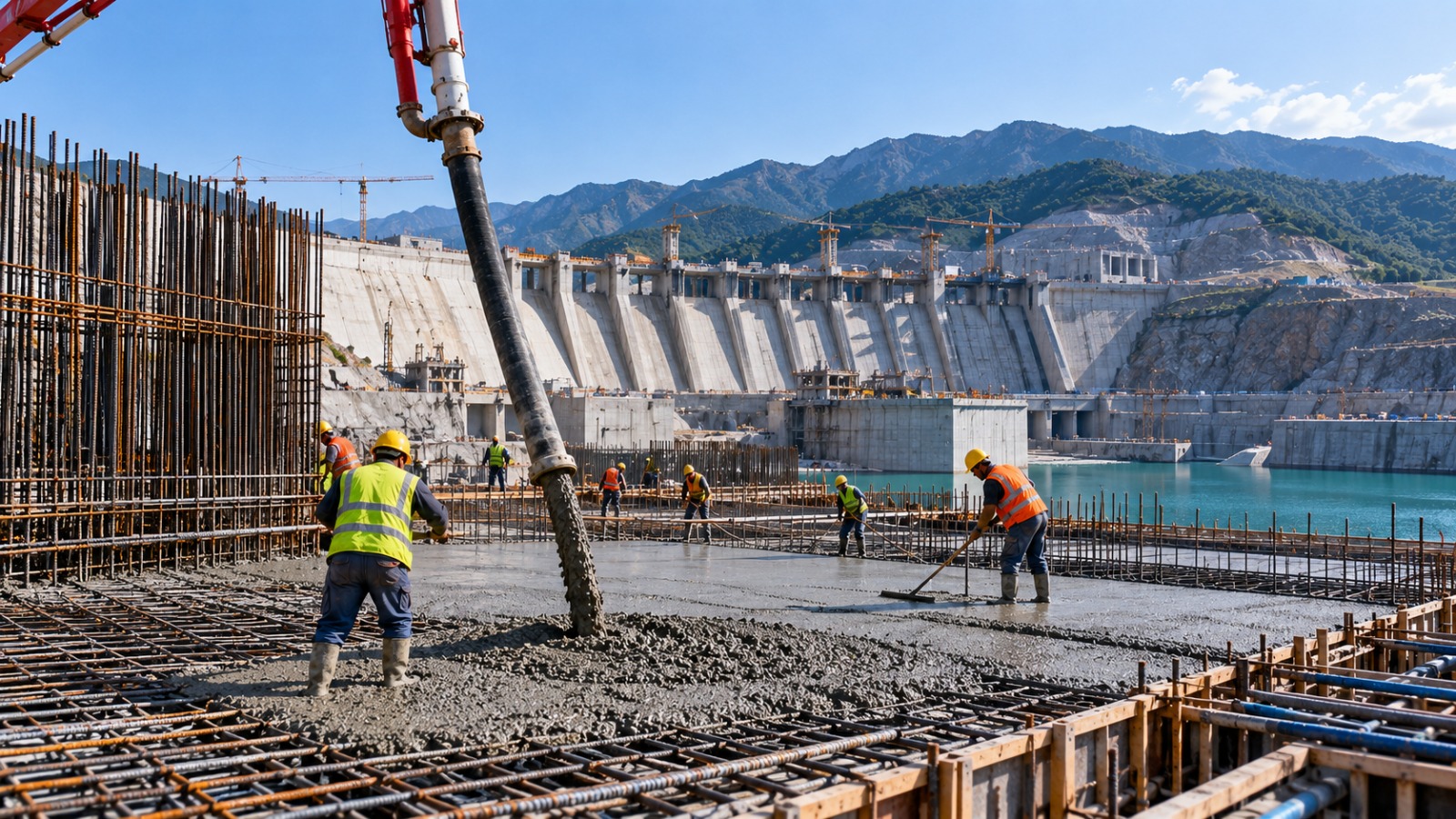
In dams, thick foundations, large raft slabs and high-volume reinforced concrete elements, temperature development inside the concrete becomes an important engineering consideration as the total concrete volume increases.

The heat generated during cement hydration can cause a significant temperature rise, especially in thick concrete sections. Large temperature differences between the inner core and outer surface of the concrete may increase thermal stresses and the risk of cracking.

For this reason, mass concrete applications should not be evaluated only in terms of compressive strength. Cement type, binder content, concrete temperature, placement schedule, curing conditions and the selected concrete admixture system should all be considered together.

The right admixture technology can help maintain workability, control setting time and achieve more balanced concrete performance with a controlled water/cement ratio.

What Is Mass Concrete?

Mass concrete refers to high-volume concrete applications where the dimensions of the concrete element can cause significant temperature differences due to the heat generated during cement hydration.

Dam structures, thick foundation slabs, large machine foundations, bridge foundations and certain heavy industrial reinforced concrete elements are common examples.

The main challenge in mass concrete is not simply the large volume of material.

Heat generated in the core of the concrete may not dissipate quickly enough, which can create significant temperature differences between the inner and outer regions.

What Is Hydration Heat in Concrete?

When cement comes into contact with water, chemical hydration reactions begin.

These reactions release energy and increase the temperature of the concrete.

In normal-sized concrete sections, heat can dissipate into the environment more easily. In large concrete masses, however, heat generated in the core can remain trapped for longer periods.

As a result, the center of the concrete may become significantly warmer than the surface.

Controlling this temperature difference is important for long-term mass concrete performance.

Why Can High Concrete Temperature Become a Problem?

Excessive internal temperature can affect hydration rate and early-age concrete behavior.

A more critical issue may occur as the concrete begins to cool.

If the internal and external regions cool at different rates, thermal volume changes develop.

When these changes generate tensile stresses greater than the early-age tensile capacity of the concrete, thermal cracking may occur.

For this reason, the objective is not simply to reduce concrete temperature, but to manage both the maximum temperature and internal temperature differences in a controlled way.

Why Is Cement Content Important in Mass Concrete?

Because cement hydration generates heat, the amount of binder used in the concrete directly affects temperature development.

Excessive cement content can increase both material cost and the total heat generated during hydration.

For this reason, the concrete mix should be optimized to achieve the required strength without using unnecessary binder.

The objective is not uncontrolled cement reduction, but the development of an optimum binder system that provides the required performance.

The Role of Mineral Components in Mass Concrete

The binder system in concrete does not necessarily consist only of Portland cement.

Depending on project specifications and applicable standards, different mineral components may be incorporated into the binder system.

These materials can influence early and final strength development, hydration behavior and workability.

When the binder system changes, the performance of chemical admixtures should also be re-evaluated.

For this reason, mineral components should be considered as part of the complete concrete mix design rather than simply as a method of reducing cement content.

Why Are Set-Retarding Concrete Admixtures Used?

Large concrete pours may continue for many hours.

To reduce the risk of undesirable cold joints between layers placed at different times, workability and setting behavior must be compatible with the placement schedule.

Set-retarding concrete admixtures can help provide more controlled setting behavior, especially during hot-weather applications or long-duration concrete pours.

However, excessive retardation may also create undesirable results.

For this reason, admixture type and dosage should be selected according to concrete temperature, cement characteristics and the actual placement program.

What Do High-Range Water-Reducing Admixtures Provide in Mass Concrete?

Large volumes of concrete must be placed and compacted efficiently and uniformly.

Adding uncontrolled amounts of water to improve workability can increase the water/cement ratio.

High-range water-reducing and water-reducing concrete admixtures can help achieve the required workability with less mixing water.

This allows placement performance to be maintained while keeping the water/cement ratio under better control.

Why Should Placement Temperature Be Controlled?

Temperature management in mass concrete does not begin after placement.

The initial temperature of fresh concrete when it leaves the batching plant can also influence the maximum temperature reached later.

Aggregate temperature, mixing water, cement temperature and ambient conditions all directly affect fresh concrete temperature.

Especially in hot weather, a high initial concrete temperature may increase the maximum internal temperature reached during hydration.

For this reason, production and placement temperatures should be monitored according to project requirements.

How Does the Placement Schedule Affect Mass Concrete?

Placing very large volumes of concrete in a single stage or too quickly can make temperature management more difficult.

For this reason, some projects divide the concrete pour into specific blocks or layers.

Placement height, sequence, time between layers and concrete placement rate should be evaluated according to project conditions.

The admixture system should also provide slump retention and setting behavior compatible with the planned construction schedule.

Why Is Slump Retention Important in Mass Concrete?

Large-scale concrete placement operations may continue for several hours.

Rapid slump loss during this period can negatively affect pumpability and placement performance.

Adding uncontrolled water on site to restore workability can change the designed water/cement ratio.

For this reason, slump-retaining and high-range water-reducing admixture systems should be optimized according to the actual transportation and placement duration.

How Do Thermal Cracks Form?

In mass concrete, the internal temperature may increase while the outer surface cools more quickly due to environmental conditions.

Later, as the entire concrete mass begins to cool, the internal regions undergo volume contraction.

If this movement is restrained by surrounding structural elements or by the concrete itself, tensile stresses can develop.

If the concrete does not yet have sufficient tensile capacity at an early age, these stresses may cause cracking.

For this reason, thermal cracking cannot be controlled by admixtures alone. It requires an integrated engineering and construction approach.

Why Is Curing Important in Mass Concrete?

Rapid loss of moisture and temperature at the concrete surface can increase the difference between the inner and outer regions.

Proper curing helps control surface moisture loss and supports more balanced hydration.

The curing method should be selected according to surface conditions, ambient temperature, wind and project requirements.

Protecting the concrete surface from sudden temperature changes is also important for thermal performance.

How Can Concrete Temperature Be Monitored?

In large-volume and critical concrete placements, internal temperature development can be monitored using measurement systems.

Temperature sensors installed at different locations within the concrete can track changes over time in both the core and surface regions.

These measurements help evaluate the maximum temperature reached and the temperature differences between different areas of the concrete.

Monitoring actual field data can also provide valuable information for optimizing future concrete pours.

The Importance of Admixture Technology in Dam Concrete

Dam projects may require extremely large quantities of concrete.

For this reason, even a small change in the concrete mix can have a significant effect on total production cost, workability and thermal performance.

The admixture system used in dam concrete should be compatible with the cement and other binders, provide suitable long-term workability and support the required mechanical properties.

After laboratory testing, production and field trials are important for verifying performance under actual project conditions.

Temperature Control in Thick Foundations and Raft Slabs

Thick raft foundations used in high-rise buildings and heavy industrial facilities may also behave as mass concrete.

These applications may require high binder contents to achieve high strength classes.

However, higher binder content can also increase heat generation.

For this reason, the balance between strength requirements and hydration heat should be evaluated through laboratory studies.

Is a Set Retarder Alone Enough for Mass Concrete?

No.

Set-retarding admixtures are an important tool, but they do not control concrete temperature by themselves.

Concrete temperature, binder system, placement volume, placement schedule, water/cement ratio and curing conditions must all be managed together.

Admixture technology is only one part of this system.

Successful mass concrete applications require several engineering measures to work together.

Which Parameters Should Be Evaluated in Laboratory Trials?

When developing a mass concrete mix, it is not sufficient to evaluate only the initial slump or 28-day compressive strength.

Slump-retention time, initial and final setting time, early-age strength, final strength and concrete temperature should also be considered.

Depending on the importance of the project, more detailed studies of heat of hydration and temperature development may also be required.

These results help optimize admixture type and dosage according to actual project conditions.

EMA Kimya Admixture Solutions for Mass Concrete and Large Infrastructure Projects

EMA Kimya develops professional concrete admixture technologies for dams, bridges, viaducts, metro projects, thick foundations, large raft slabs, concrete batching plants and large-scale infrastructure projects.

High-range water-reducing, water-reducing, slump-retaining and set-retarding admixture systems can be optimized according to the cement and binder system, aggregate characteristics, concrete temperature, transportation and placement duration, target setting time and strength requirements.

EMA Kimya's technical approach focuses not only on workability, but also on improving temperature control, setting management, low water/cement ratio, strength, production consistency and long-term concrete performance together.

Successful mass concrete design is not only about achieving high strength; it is about controlling temperature and performance development from the first hours of placement throughout the long service life of the structure.

Related News

The Importance of Set-Retarding Concrete Admixtures in Hot Weather and Long Transportation Times

Publication Date: 01 Ekim 2026

What Is an Air-Entraining Concrete Admixture? How Is Freeze-Thaw Resistant Concrete Produced?

Publication Date: 01 Ekim 2026

Why Do Segregation and Bleeding Occur in Concrete? The Right Admixture Technology for Homogeneous Concrete

Publication Date: 01 Ekim 2026

What Is Cement-Admixture Incompatibility? How Can Rapid Slump Loss, Setting Problems and Admixture Performance Be Controlled in Ready-Mixed Concrete?

Publication Date: 01 Ekim 2026

What Is a Set-Accelerating Concrete Admixture? How Can Setting Time and Early Strength Be Controlled in Cold Weather?

Publication Date: 01 Ekim 2026

More Durable Concrete Against Freeze-Thaw Cycles with Air-Entraining Admixtures

Publication Date: 01 Ekim 2026

High Flowability and Controlled Concrete Performance with Self-Compacting Concrete Admixtures

Publication Date: 01 Ekim 2026

What Are Construction Chemicals and Where Are They Used?

Publication Date: 01 Ekim 2026

What Are Polycarboxylate-Based Concrete Admixtures? Next-Generation Superplasticizer Technology

Publication Date: 01 Ekim 2026

How Can Concrete Workability Be Improved?

Publication Date: 01 Ekim 2026

Shotcrete Admixtures for Fast and Controlled Application in Tunnel and Underground Projects

Publication Date: 01 Ekim 2026

Support Surface Strength and Long-Term Performance with Concrete Curing and Protection Products

Publication Date: 01 Ekim 2026

How to Improve Quality in Ready-Mixed Concrete Production

Publication Date: 01 Ekim 2026

What Causes Segregation and Bleeding in Concrete? How Can Homogeneous Concrete Be Achieved?

Publication Date: 01 Ekim 2026

What Is a Superplasticizer and What Does It Do?

Publication Date: 01 Ekim 2026

Web Design & Software | COUR Media