English
×
All rights reserved. All content and images used on this website
belong to EMA Kimya and may not be used without permission.
cour
 EMA Kimya | Concrete Admixtures, Cement Additives, Construction Chemicals, Superplasticizers, High-Range Water Reducers, Concrete Performance Solutions, Ready-Mix and Precast Concrete Technologies, Infrastructure, Industrial Projects, Technical Support, Production and Cost Consulting  EMA Kimya | Concrete Admixtures, Cement Additives, Construction Chemicals, Superplasticizers, High-Range Water Reducers, Concrete Performance Solutions, Ready-Mix and Precast Concrete Technologies, Infrastructure, Industrial Projects, Technical Support, Production and Cost Consulting
EMA Kimya | Concrete Admixtures, Cement Additives, Construction Chemicals, Superplasticizers, High-Range Water Reducers, Concrete Performance Solutions, Ready-Mix and Precast Concrete Technologies, Infrastructure, Industrial Projects, Technical Support, Production and Cost Consulting

"Strength in Every Mix,
Quality in Every Drop"

×

Quality, reliability, and a commitment to sustainable production.

We provide professional solutions in concrete admixtures and construction chemicals.

Menu

Quality, reliability, and a commitment to sustainable production.

We provide professional solutions in concrete admixtures and construction chemicals.

01 October 2026

In ready-mixed concrete production, superplasticizers and water-reducing admixtures are among the main components of many concrete mix designs. However, in some applications, using only the primary plasticizing admixture may not be enough to achieve all of the required performance characteristics.

Aggregate properties, fine material content, concrete temperature, transportation time, pumpability requirements and project conditions can significantly affect concrete behavior.

In such cases, auxiliary concrete admixtures are special chemical systems used to help control specific concrete properties more effectively.

The right auxiliary admixture system can support the performance of the primary admixture, help improve mix stability and make it easier to adapt production to changing conditions.

What Is an Auxiliary Concrete Admixture?

Auxiliary concrete admixtures are chemical products used to support the main admixture system and regulate specific fresh or hardened concrete properties.

Their purpose varies according to the concrete mix design and the production problem being addressed.

Improving mix stability, controlling viscosity, adjusting consistency behavior, managing setting time and supporting special concrete applications are among the areas where auxiliary admixtures may be used.

For this reason, auxiliary concrete admixtures are not a single product category, but a broad group of performance-supporting systems.

What Is the Difference Between a Primary Admixture and an Auxiliary Admixture?

The primary admixture system is generally selected to meet the main performance requirement of the concrete.

For example, a high-range water-reducing admixture may be used to achieve high workability at a lower water content.

However, if the same mix develops a segregation tendency at high flowability or requires additional control during long transportation periods, an auxiliary system may also be used.

The objective is not to replace the primary admixture, but to complete the performance balance required by the concrete mix.

Why Is Concrete Mix Stability Important?

High flowability alone does not mean that concrete has good overall performance.

Aggregates, cement paste, water and fine materials should move together throughout the mixture.

If mix stability is insufficient, coarse aggregate may separate, water may rise to the surface or different regions of the concrete may develop different compositions.

For this reason, especially in highly flowable concrete, the correct balance between flowability and stability is essential.

Auxiliary concrete admixtures can play an important role in supporting this balance.

Why Is Viscosity Control Necessary?

Concrete viscosity is related to the resistance of the mixture to flow and the ability of its components to move together.

Very low viscosity may make concrete excessively mobile and increase the risk of aggregate segregation.

Very high viscosity can make pumping and movement through formwork more difficult.

For this reason, optimum viscosity is especially important in high-performance and highly flowable concrete.

Suitable auxiliary admixtures can help preserve flowability while supporting mixture cohesion and stability.

Auxiliary Admixtures in Self-Compacting Concrete

Self-compacting concrete is a highly flowable concrete capable of filling formwork under its own weight and passing through dense reinforcement.

In these applications, segregation resistance is just as important as high flowability.

Concrete should flow easily without allowing coarse aggregates to separate from the cement paste.

For this reason, suitable auxiliary admixture technologies may be used together with high-performance superplasticizers when necessary.

The objective is to ensure both easy movement and a homogeneous concrete structure.

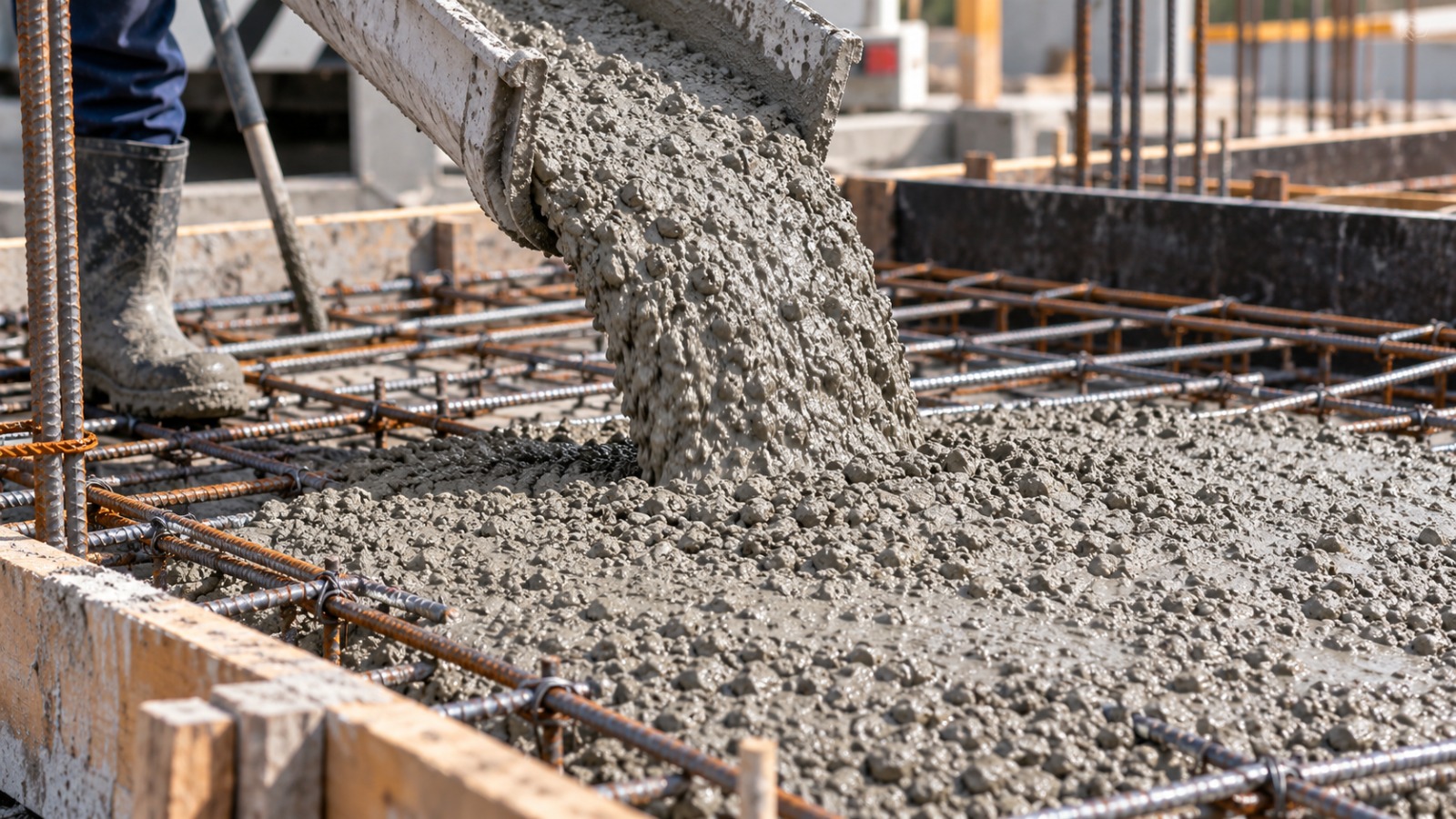
Why Can Auxiliary Admixtures Be Used in Pumped Concrete?

Pumpable concrete must move through the pump line in a homogeneous and stable manner.

Separation of coarse aggregates from the paste phase can cause irregular flow and increased pump pressure.

A mixture that is too dry can also increase pumping resistance.

For this reason, water/cement ratio, aggregate grading, fine material content and chemical admixtures should be evaluated together.

A suitable auxiliary admixture system can help maintain concrete stability during pumping.

How Do Changes in Aggregates Affect Concrete Performance?

Aggregate characteristics in ready-mixed concrete plants may not always remain completely constant.

Changes in quarry source, particle-size distribution, moisture content or fine material content can alter concrete behavior.

In particular, changes in fine materials and clay content may affect water demand and admixture demand.

In such cases, simply increasing the dosage of the primary admixture may not always be the correct solution.

The complete concrete mix design should be evaluated and the auxiliary admixture system should be re-optimized when necessary.

Why Is Fine Material Content a Critical Parameter?

Cement and other fine components help fill the spaces between aggregate particles and support mixture cohesion.

Insufficient fine material content may reduce concrete stability.

Excessive fine material can increase water demand and chemical admixture demand.

For this reason, the objective should not be to maximize fine material content, but to create an appropriate fine material balance.

Auxiliary admixtures can support this balance, but they should not be considered a stand-alone solution for an unsuitable aggregate system.

Can Auxiliary Admixtures Help Reduce Segregation and Bleeding?

Suitable auxiliary admixture technologies may help improve mix stability in certain concrete formulations.

However, when segregation or bleeding occurs, it is not correct to focus only on the admixture.

Water content, aggregate grading, fine material ratio, mixing time and placement method should also be checked.

Once the actual cause of the problem is identified, the concrete mix and admixture system should be optimized together.

Use of Auxiliary Admixtures in Hot Weather

High temperatures can significantly affect workability and setting behavior.

As concrete temperature increases, slump loss may accelerate and application time may become shorter.

This is especially important in ready-mixed concrete applications with long transportation distances.

Evaluating project-specific auxiliary admixtures together with the main plasticizing system can help manage time-dependent concrete behavior more effectively.

Concrete Performance in Cold Weather

At low temperatures, cement hydration may slow down and early-age concrete performance may change.

For this reason, using the same summer mix design during winter without adjustment may not always provide the same results.

Cement type, concrete temperature, transportation time and target setting behavior should be re-evaluated.

Seasonal mix optimization helps achieve more consistent production in ready-mixed concrete plants.

Do Auxiliary Admixtures Affect Concrete Strength?

Not every auxiliary admixture has the same purpose.

Some systems are mainly used to control fresh concrete behavior, while others may support specific hardened concrete properties.

However, admixture use should never be evaluated independently from final concrete performance.

When changing the product or dosage, early-age and 28-day compressive strength results should also be checked.

Why Is Compatibility Between Admixtures Important?

When more than one chemical admixture is used in the same concrete mix, the products can interact with each other.

Superplasticizers, set-controlling admixtures, air-entraining admixtures and auxiliary admixtures can influence fresh concrete behavior when used together.

The fact that two products perform well individually does not automatically mean they will provide the same performance when combined.

Admixture combinations should therefore be tested using the actual cement and aggregates.

How Should Auxiliary Admixture Dosage Be Optimized?

Correct dosage is critical for auxiliary admixtures.

Insufficient dosage may fail to provide the expected effect.

Excessive dosage may negatively affect viscosity, setting behavior or cost.

For this reason, dosage should be determined through laboratory trials at different usage levels.

The objective is not the highest dosage, but the optimum dosage that provides the most balanced overall concrete performance.

How Should the Cost of Auxiliary Concrete Admixtures Be Evaluated?

Evaluating an auxiliary admixture only by its price per kilogram is not sufficient.

The technical problem it solves and the contribution it provides to production should also be considered.

More stable concrete, more controlled pumping, fewer site problems and more consistent production can all affect total cost.

For this reason, admixture cost should be evaluated together with the overall technical benefit provided per cubic meter of concrete.

Why Is Continuous Control Important in Ready-Mixed Concrete Plants?

A concrete mix does not necessarily provide identical performance forever after it has been designed.

Cement deliveries, aggregate moisture, fine material content and ambient temperature may change over time.

These changes can affect the behavior of concrete admixtures.

For this reason, regular quality control and periodic mix optimization are important in ready-mixed concrete plants.

The admixture system can be adjusted according to changes in concrete performance.

Use of Auxiliary Concrete Admixtures in Central Anatolia

Seasonal temperature differences and varying raw material sources in Central Anatolia can create significant changes in concrete performance.

Concrete plants in Konya, Ankara, Kayseri, Aksaray, Karaman, Niğde, Nevşehir, Kırşehir, Eskişehir, Sivas and Yozgat may use different cement and aggregate sources.

For this reason, primary and auxiliary admixture systems used in regional ready-mixed concrete production should be tested with local raw materials.

Laboratory and plant trials carried out under actual conditions provide more reliable results.

What Should Be Evaluated in Laboratory Trials?

Measuring only the initial slump is not sufficient when evaluating an auxiliary admixture.

Initial and time-dependent consistency, segregation tendency, bleeding, air content, concrete temperature and setting behavior can all be monitored.

Early and final strength results should also be checked in hardened concrete.

This makes it possible to evaluate the effect of the admixture on overall concrete performance rather than on a single property.

EMA Kimya Auxiliary Concrete Admixture Solutions

EMA Kimya develops professional concrete admixture technologies for ready-mixed concrete plants, batching plants, precast and prefabricated manufacturers, self-compacting concrete, pumped concrete and high-performance concrete applications.

Primary and auxiliary admixture systems can be optimized according to cement characteristics, aggregate grading, fine material content, concrete temperature, transportation time and target concrete performance.

EMA Kimya's technical approach focuses not only on modifying a single concrete property, but on improving workability, mix stability, consistency control, pumpability, strength and production continuity together.

The right solution in auxiliary concrete admixtures is not to add more chemicals to the mix, but to identify the actual requirement of the concrete and create a controlled performance balance that works in harmony with the primary admixture system.

Related News

The Importance of Set-Accelerating Admixtures in Cold Weather Concrete Applications

Publication Date: 01 Ekim 2026

What Are Concrete Admixture Dosing Errors? Correct Storage and Use in Ready-Mixed Concrete Plants

Publication Date: 01 Ekim 2026

What Is a Set-Retarding Concrete Admixture? How Can Concrete Setting Time Be Controlled in Hot Weather?

Publication Date: 01 Ekim 2026

What Are Concrete Admixtures? Types and Applications

Publication Date: 01 Ekim 2026

What Is Alkali-Silica Reaction (ASR) in Concrete? How Can Internal Cracking and Long-Term Durability Loss Be Prevented?

Publication Date: 01 Ekim 2026

How Can Ready-Mixed Concrete Production Costs Be Reduced? Mix Design and Cost Optimization with Concrete Admixtures

Publication Date: 01 Ekim 2026

Higher and More Consistent Concrete Performance with Strength-Enhancing Admixtures

Publication Date: 01 Ekim 2026

What Causes Segregation and Bleeding in Concrete? How Can Homogeneous Concrete Be Achieved?

Publication Date: 01 Ekim 2026

Support Surface Strength and Long-Term Performance with Concrete Curing and Protection Products

Publication Date: 01 Ekim 2026

How Can Concrete Strength Be Increased?

Publication Date: 01 Ekim 2026

More Durable Concrete Against Freeze-Thaw Cycles with Air-Entraining Admixtures

Publication Date: 01 Ekim 2026

How to Improve Quality in Ready-Mixed Concrete Production

Publication Date: 01 Ekim 2026

The Importance of Concrete Admixtures in the Construction Industry

Publication Date: 01 Ekim 2026

What Are Construction Chemicals and Where Are They Used?

Publication Date: 01 Ekim 2026

Why Do Honeycombing and Voids Occur in Concrete? The Right Application and Admixture Technology for More Homogeneous Concrete

Publication Date: 01 Ekim 2026

Web Design & Software | COUR Media